This is the formal AT2 submission for the Master of Education (Digital Learning) at Monash University 2026. If you are viewing my portfolio, go back to the project page.
How might we design a learning experience that gives Indonesian migrants in Melbourne the cultural confidence and professional guidance they need to enter the Australian workforce, built by someone who walked the same path?
Stanford d.school design thinking + Growth framework
Two sessions. One real job offer. A human-centred communication program for internationally qualified migrants navigating confidence, communication, and employability in Australia.
The Confident Communicator,
a five-week hybrid program.
The Confident Communicator is a five-week hybrid English communication program I designed and facilitated under my coaching practice, English With Mia. It serves students in Melbourne attending in person and students in other locations including Perth participating via Zoom. It is designed specifically for internationally qualified migrants who face a structural barrier in professional communication, interview confidence, and resume presentation that is distinct from, and not reducible to, English language proficiency.
Between sessions, students access course materials, weekly challenges, and session recordings through a dedicated Notion learning hub. WhatsApp supports community building and ongoing communication between formal sessions, and Canva is used as a live collaborative workspace during class activities. These tools were selected not for novelty but because they address the specific access and flexibility constraints that working migrants face (Bonk and Graham, 2006; Kirschner and Erkens, 2013).
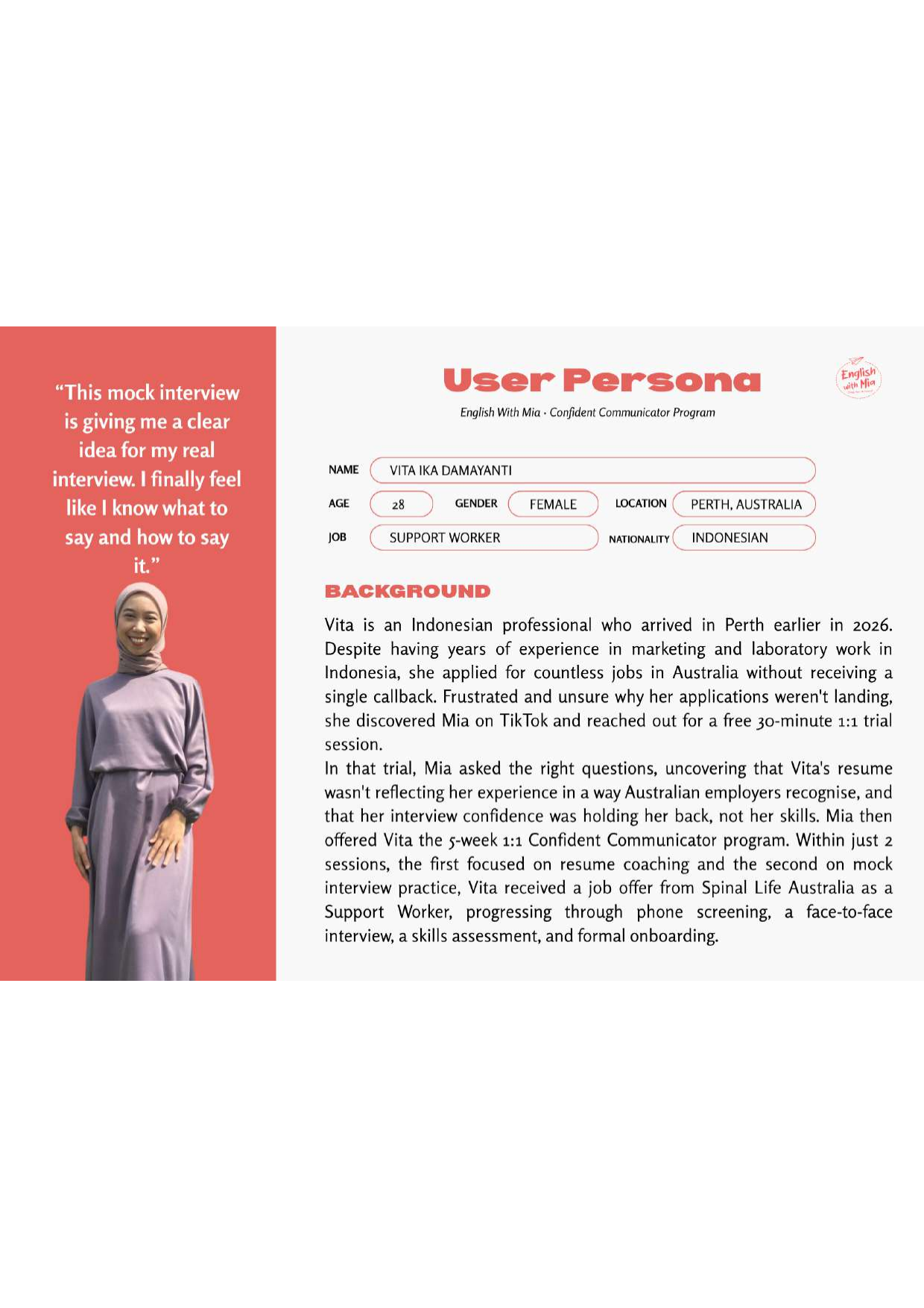
My first real participant, Vita Ika Damayanti, arrived in Perth earlier in 2026 with years of professional experience in marketing and laboratory work. She received no callbacks despite applying for countless jobs, not because her skills were insufficient, but because the gap between what she knew and how Australian employers expected her to present it was never addressed by any program she had accessed. After just two sessions focused on CV coaching and mock interview practice, she received a job offer from Spinal Life Australia as a Support Worker. My second enrolled student, Nur Rofiqoh Utami, joined the program in May 2026. The full five-week group cohort of 6 to 10 students remains hypothetical, designed and planned from the real evidence gathered from Vita, Nur, and 14 informal community conversations conducted via a WhatsApp webinar with Indonesian migrants aged 20 to 35 in Melbourne.
In AT1, I proposed a gamified microlearning solution as a response to low engagement in online English learning. The problem as I defined it then was a product-level problem: how do I make language learning more engaging? That framing reached for a technology solution before it properly investigated the human problem. It skipped empathy and went straight to ideation, which is precisely what Stanford d.school's model is designed to prevent (Brown, 2008; Liedtka, 2018).
Clare's feedback on AT1 named the gap directly: lack of engagement is not genuinely wicked because it can be addressed by increasing engagement. There is a stopping rule. There is a testable solution. A wicked problem, as Rittel and Webber (1973) define it, resists straightforward resolution because every stakeholder defines it differently and every solution changes the conditions. Gamification addresses a surface symptom; it does not touch the structural reality.
What changed the direction of AT2 was the Empathise stage doing its actual job. Vita's pre-session welcome form, completed 28 April 2026, showed me that the barrier was not engagement. Her confidence scores of 2/10 for professional writing and 4/10 for spoken English in interviews were the scores of someone who had been applying for jobs for months without a single callback. The problem was structural, cultural, and deeply personal: a confidence and communication gap shaped by accent bias, the devaluation of overseas credentials, and a mismatch between what Australian employers expect and what migrants have been taught to present (Jentjens, 2021; Baker et al., 2023).
The 14 informal community conversations confirmed that Vita's experience was systemic, not individual. These were conducted verbally via a WhatsApp-based community webinar hosted by English With Mia in March 2026, with Indonesian migrants aged 20 to 35 living in Melbourne. Participants were recruited through Mia's existing network. No written instrument was used. The data is self-selecting and directional, not generalisable, but it validated that the barriers Vita described, zero callbacks despite strong experience, uncertainty about resume framing, and low interview confidence, were shared widely across the group, not unique to her situation. Brown and Wyatt (2010) argue that design thinking for social innovation requires prototyping at small scale before rolling out, with evidence at the centre rather than assumption. That is exactly what Sessions 1 and 2 with Vita were. The AT1 to AT2 pivot is not a gap in the design process. It is the design process working.
Why the methodology had
to change between submissions.
In AT1, I proposed gamified microlearning for Indonesian adult online English learners, using the Design Council's Double Diamond as the design methodology. During the Empathise stage of AT2, real evidence from Vita's welcome form, professional writing confidence 2 out of 10 and interview confidence 4 out of 10, and 14 informal community conversations revealed the real problem was not digital engagement. It was cultural self-presentation confidence in Australian professional contexts. No gamified module could address that. The methodology had to change.
- Methodology: Design Council Double Diamond (Design Council, 2019)
- Context: Indonesian adult learners in Indonesia
- Problem diagnosed: learner disengagement in self-paced digital modules
- Solution: gamified microlearning with XP, badges, streak tracking
- Outcome: hypothetical, never piloted with real participants
- Methodology: Stanford d.school five-stage design thinking (Brown, 2008)
- Context: Indonesian migrants in Australia
- Problem diagnosed: cultural self-presentation confidence gap in Australian professional contexts
- Solution: five-week hybrid coaching program, resume, interview, communication, networking, integration
- Outcome: Vita Ika Damayanti received a job offer from Spinal Life Australia after two sessions
Double Diamond is a problem-to-solution framework. It works when the designer knows the problem category in advance. Stanford d.school puts Empathise first, before any problem statement, because it does not assume the designer already knows what the human experience of the problem is. For a wicked problem involving human identity and cultural navigation, that assumption cannot be made safely.
The qualified migrant
no one calls back.
Rittel and Webber called these wicked problems: socially embedded, no single cause, no clean solution. For internationally qualified migrants in Australia, the wicked problem has a face, a name, and an emotional timeline.
Degree. Experience. Written English strong.
Figure 1 · Wicked problem network
Six systems. One employment gap.
Tap any outer circle to see how that system contributes to the gap and the evidence behind it.
- · Self-promotion ("I led") not understated team voice ("we did")
- · Eye contact, small talk, handshake choreography
- · Resume framing that translates overseas roles for AU sectors
- · Interview tone that sounds confident, not arrogant or hesitant
Not a deficit story. Migrants are not the problem. The problem is the gap between their real capability and the unspoken cultural rules used to assess it.
Figure 2 · Stakeholders in the wicked problem
Five players. One stuck candidate
in the middle.
A wicked problem has no single owner. Five stakeholders shape the migrant employability gap, each with different power, different intent, and the same blind spot. Tap a stakeholder to see what they actually do, and what they routinely miss.
Each stakeholder pulls the candidate in a different direction. None of them owns the outcome.
Stakeholder 01 of 5
High power · Low interest
Governments
Visa, skills assessment, IELTS gatekeepers
Set the bar, then walk away from outcomes.
Define skilled-migration categories, accredit qualifications, and require IELTS or PTE thresholds before issuing visas.
A 7.0 in IELTS does not teach you how to open a Monday stand-up, decline a meeting, or self-promote in an Australian interview.
Adapted from Rittel & Webber (1973) and Mendelow's stakeholder matrix. The candidate in the middle is the only one who feels every pull at once.
Rittel and Webber, mapped
to real project evidence.
Rittel and Webber (1973) define a wicked problem as one structurally resistant to resolution. The communication and confidence gap facing internationally qualified migrants in Australia meets every one of their eight criteria.
Three systemic levels.
Structural hiring norms, IELTS gatekeeping, and the systemic devaluation of overseas credentials create the conditions Vita encountered before she ever found English With Mia. Baker et al. (2023): features of an assessment infrastructure built around culturally homogeneous criteria. No individual coaching program can change this level.
The absence of culturally responsive employment support, reliance on generic English courses, and the gap between employer expectations and migrant communication norms create the immediate barrier my students face. Denning-Smith (2020) frames this as a design problem, not a language problem. This is the level at which the Confident Communicator operates.
The individual experiences of low confidence, zero callbacks, and the psychological weight of repeated rejection shape what every student brings into the first session. Jentjens (2021) confirms these experiences directly suppress professional performance even when competence is not in question.
What makes this problem genuinely wicked is not that it is hard to solve at any one level. It is that every time one layer is addressed, the next surfaces. Vita got the job. The wicked problem did not.
Empathy first. Then everything else.
The Empathise stage is not a preliminary step that makes the real work possible: it is the most consequential design decision I made. Stanford d.school's model places empathy at the start because the designer's assumptions about what users need are typically wrong until tested against real human experience (Brown, 2008). The empathy work I conducted before designing a single session reshaped the entire program, including the pivot away from AT1.
The primary empathy instrument was a Pre-Session Welcome Form built and administered via Google Forms, completed by Vita on 28 April 2026. Her responses were specific, honest, and structurally significant: a 2/10 confidence score for professional writing, a 4/10 for spoken English in interviews, and a direct statement that she did not know how to write an outstanding resume or cover letter. These were not vague expressions of anxiety; they were a precise diagnosis of where the intervention needed to land (Peng and Kueh, 2022).
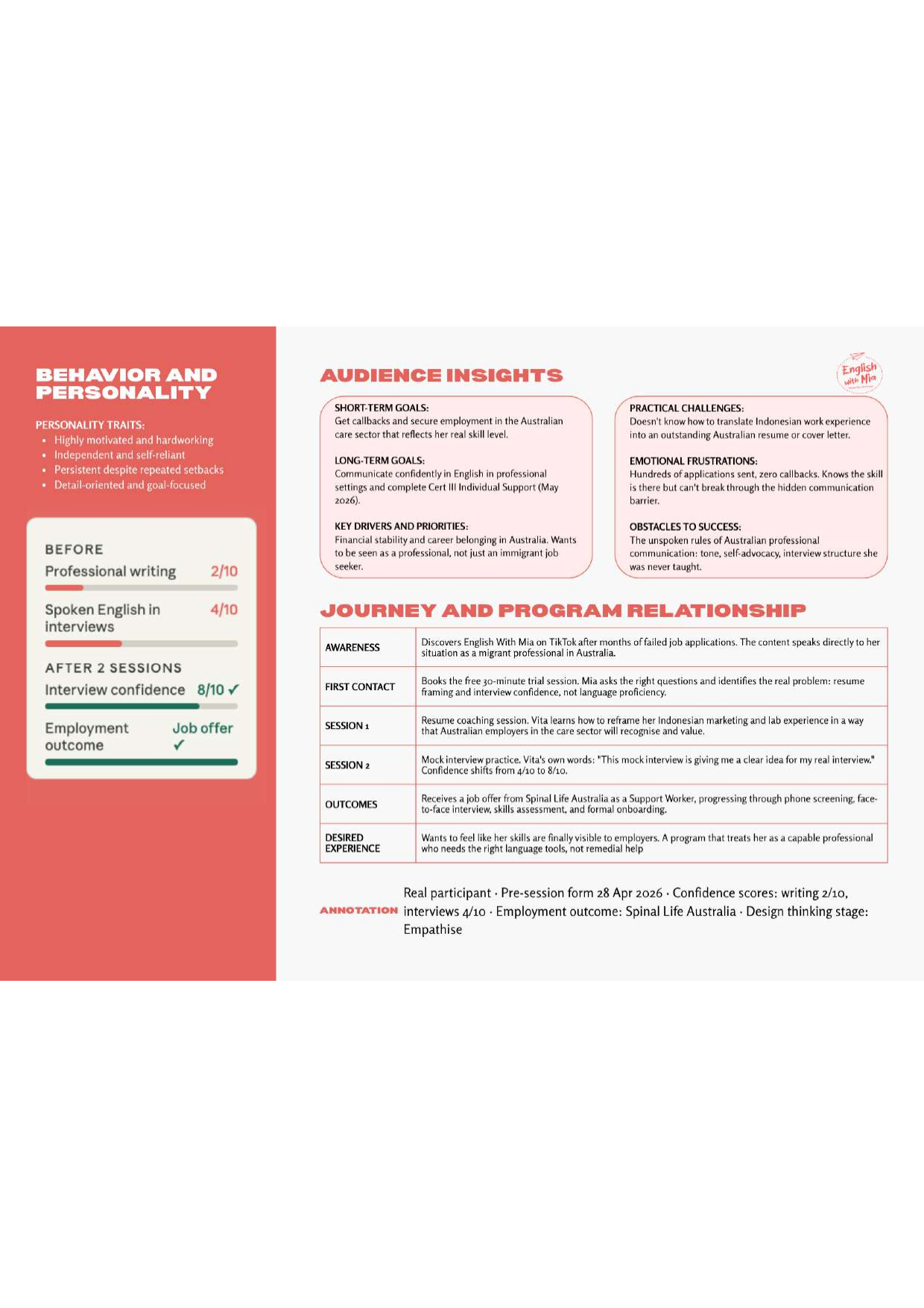
applied for 10+ jobs with no callback
had never completed a mock interview in English
identified resume writing as their biggest barrier
Derived from 14 self-selecting participants in an informal researcher-facilitated WhatsApp webinar (English With Mia, March 2026; Indonesian migrants aged 20 to 35, Melbourne). Directional only, not generalisable.
Baker et al. (2023) argue that the starting point for inclusive design must be the recognition that migrants already hold strong capabilities. Treating Vita's welcome form as the primary design document positioned her as a co-designer of the intervention that would serve her, not as a subject to be assessed.
One real person.
One real outcome.
Vita is the empathy anchor of this entire program. Her welcome form, her two sessions, and her job offer are the evidence base every other artefact rests on.
Communication trail and welcome form data
Pre-Session Welcome Form Evidence
VITA IKA DAMAYANTI
Indonesian professional with 5 years marketing experience in health and laboratory services. In Australia on a 485 dependent visa. Planning Cert III Individual Support and PR pathway.
- Dream job:
- Individual support worker, PR pathway, further study in nursing.
- Professional writing confidence:
- 2 out of 10
- Spoken English in interviews:
- 4 out of 10
"Deliver skill and experience I have related to the job that I applied. Don't know how to make outstanding resume or cover letter."
"Confidently communicating through English writing for making a resume, cover letter, explaining basic things in a best way."
NUR ROFIQOH UTAMI (Tammy)
From Salatiga, Central Java. Bachelor in Garment Production, Master's in Business Administration (China). HR and Administration at China National Offshore Oil Company in Jakarta. Currently in Melbourne on Working Holiday Visa.
- Dream job:
- Hospitality, tourism, open to new industries. Seeking PR pathway.
- Professional writing confidence:
- 6 out of 10
- Spoken English in interviews:
- 8 out of 10
"Finding the right opportunity that matches my background while adapting to a new environment. I want to improve my confidence and communication skills in interviews, especially in professional English."
"Gaining more confidence in job applications and interviews, improving my professional communication skills, and securing a suitable job in Australia."
Data source: Pre-Session Welcome Form administered via Google Forms, The Confident Communicator, English With Mia 2026. Vita completed 28 April 2026. Nur completed 7 May 2026. Personal contact details withheld.
Zero callbacks.
- · 60+ applications sent
- · Writing confidence 2/10
- · Interview confidence 4/10
- · "Don't know how to make an outstanding resume."
Job offer from Spinal Life Australia.
- · Interview confidence 4/10 → 8/10
- · Phone → face-to-face → skills assessment → onboarding
- · "Giving me a clear idea for my real interview."
- · Becomes peer advocate for next cohort
Thank you so much Mia, this mock interview is giving me a clear idea for my real interview
YAY so happy to hear that!!! Can't wait to hear the great news. Break a leg kak Vita 🥰😍
Hi Vita Ika,
Thank you for attending our interview and skill assessment day. We would like to progress with your application and require documents before we can make an offer of employment. Please see below the list of documents we require from you:
Nur. And the cohort that followed.
Shortly after Vita's offer, the same two-session structure was run with Nur and other internationally qualified students at English With Mia. Different industries, same wicked problem, similar shift in confidence and callbacks. Vita stopped being a single data point and started being a pattern.
Positioning is the start.
Interactions are the story.
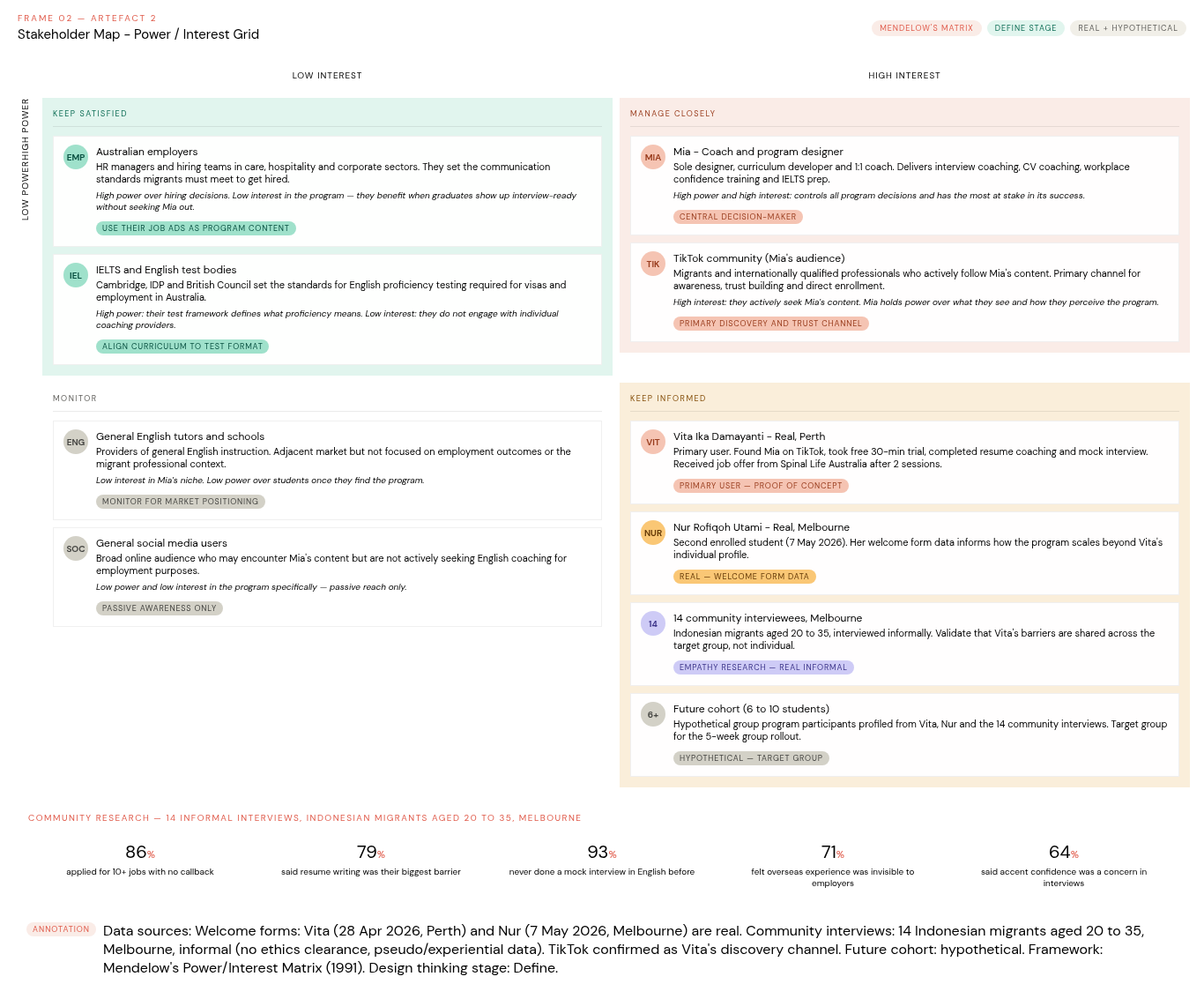
Mendelow's Power/Interest Matrix (1991) tells me how to communicate with each stakeholder. It does not tell me how stakeholders interact with each other to produce the conditions my students face. This section traces three of those interaction chains.
IELTS bodies sit in Keep Satisfied: high power, low interest in any individual coaching program. They set proficiency standards that Australian visa and employment processes use as a proxy for communication competence. That benchmark feeds directly into employer hiring decisions. Employers in Keep Satisfied apply that standard without input into whether it is culturally calibrated. Baker et al. (2023) make this argument precisely: the problem is not a deficit of graduate capitals but a deficit of legibility. The influence chain runs from IELTS bodies (defining proficiency) to employers (applying that definition) to Vita (experiencing the outcome as zero callbacks and a 4/10 confidence score).
TikTok sits in Manage Closely: high interest, actively engaged with Mia's content, and the primary discovery channel through which Vita found the program. Thondhlana et al. (2016) argue that social capital and networking strategies determine outcomes for highly skilled migrants more than qualifications alone. The content Mia creates on TikTok is doing design work: it reaches migrants already filtered out by the employer-IELTS chain and offers an alternative path into visibility. That is not marketing; it is a capital-building intervention outside the institutional channels that failed Vita.
Critically, TikTok's algorithm also shapes who the program reaches. It privileges content performing well with an already-engaged audience, overlapping with the sampling bias in the 14 informal community conversations conducted via a WhatsApp webinar. Peng and Kueh (2022) warn that designers without diverse perspectives risk reproducing the blind spots of their own position. TikTok is a genuine strength and a structural filter that may be systematically excluding the most isolated migrants from finding the program at all.
As both sole designer and sole facilitator, Mia sits in high-power, high-interest. A sole designer working alone is structurally at risk of designing for the students they already understand rather than the full range of students who need the program. Vita and Nur both found Mia through TikTok. Liedtka (2018) argues design thinking's effectiveness depends partly on the diversity of perspectives brought to the process. The iteration plan in Section 6 addresses this through peer outreach and community recruitment beyond existing networks.
This case study is the
best-selling program at English With Mia.
The Confident Communicator runs today as Career Fluency with 5 active students. Online while it grows. From June 2026, the program moves in-person in Melbourne so every student gets the mock-interview practice that produced Vita's job offer.

This AT2 project is part of the Master of Education (Digital Learning) at Monash University 2026. It is also a real program with a real student and a real employment outcome.