 Chef's Special
The Confident Communicator
The Chef's Special, designed from real empathy, tested on a real person, proven by a real job offer. A 5-week in-person English communication program for internationally qualified migrants in Australia.
Flavour: Strawberry Shortcake
Client
English With Mia (self-initiated)
Role
Instructional Designer & Program Designer
Tools
Stanford d.school Design Thinking (Brown, 2008) · Designing for Growth framework · Miro · Canva · Google Forms · In-person coaching
Project brief
The Confident Communicator is a 5-week in-person English communication program I designed and facilitated under my coaching practice, English With Mia. The program is based in Melbourne, and is designed for internationally qualified migrants who have the skills and experience to contribute to the Australian workforce but face a significant barrier in professional communication, interview confidence, and resume presentation.
Key ingredients
- •14 community interviews with Indonesian migrants aged 20, 35 in Melbourne
- •Real participant welcome form data (Vita Ika Damayanti)
- •User persona, stakeholder map, journey map, customised Stanford model
- •5-week program from voice & story to mock interview showcase
- •Validated against Liedtka & Ogilvie's 'What works?' question
The Parlour Method, applied
The recipe
Same five stages as every scoop on the homepage, flavoured for this project.
- 1Empathise
Pre-session welcome form. Vita's confidence scores: writing 2/10, interviews 4/10. 14 community interviews with Indonesian migrants aged 20 to 35 in Melbourne.
- 2Define and Imagine
Wicked problem named. Stakeholder map built. User persona created from real data. Vita's own words: 'I don't know how to make an outstanding resume or cover letter.'
- 3Ideate and Wow
5-week program structure generated from Vita's real barriers. Mock interviews chosen over grammar drills. Free 30-minute trial kept as a permanent design feature.
- 4Prototype and Build
Session 1 with Vita: resume and CV coaching. Session 2: mock interview practice. Real pilot sessions before any group program was designed.
- 5Test and What Works
Vita receives a job offer from Spinal Life Australia. Confidence shifts from 4/10 to 8/10. Validated using Liedtka and Ogilvie's 'What works?' question.
2
sessions to a job offer
4/10 → 8/10
interview confidence shift
1
real student. Real outcome. Spinal Life Australia.
The wicked problem
Internationally qualified migrants in Australia cannot convert their qualifications into employment because of a communication and confidence gap shaped by accent bias, unfamiliar workplace norms, and the devaluation of overseas credentials. This problem has no single solution, it shifts every time you try to address it.
Why do qualified migrants still struggle to get hired in Australia?
The problem is not just English proficiency. It is the hidden curriculum of confidence, culture, and communication.
A real learner profile
On paper, she should be hired tomorrow.
Degree
University-qualified in marketing & lab science
Professional experience
Years of work overseas in her field
Strong written English
Clear, structured, professional
Motivation
Determined, prepared, ready to contribute
Vita's story
The emotional journey of a qualified migrant.
This is the arc empathy research surfaced again and again, long before any curriculum could respond to it.
- Stage 01🎓
Qualified
Degree, professional experience, written English. Ready on paper.
- Stage 02✨
Hopeful
Arrives in Australia ready to contribute. Sends application after application.
- Stage 03📭
Repeated rejection
Silence. Auto-replies. No callbacks. The system gives no feedback to learn from.
- Stage 04🌧️
Self-doubt
She begins to wonder if the problem is her, not the system. Confidence quietly erodes.
Thondhlana et al. (2016); Tran et al. (2023): migrant employability is shaped by accumulating barriers across identity, capital, and recognition, not by a single deficit.
The hidden curriculum
Tap a word. These are the things nobody teaches.
A coded phrase that often filters out anyone unlike the existing team.
Baker et al. (2023): CALD graduates face structural gaps between the capitals they hold and the capitals employers recognise.
Systems map
Six stakeholders. One shifting problem.
Select any node. The others reorganise around it, that is what makes the problem wicked.
Stakeholder lens
Migrants
Read repeated rejection as personal failure rather than systemic bias.
Confidence & belonging
Capability is rarely the problem. Confidence is.
Drag the slider to feel the gap migrant learners carry into every interview, technically ready, yet quietly uncertain they belong in the room.
The gap
Belonging unlocked. Capability and confidence finally aligned.
Wicked problems don't get solved. They get met, with empathy, iteration, and humans in the room.
That is where this program begins: a human-centred learning design built around confidence, belonging, communication, and employability.
Closing reflection
“How might we redesign communication learning for belonging, not just employability?”
Mia Rosmiati · The Learning Parlour
The student behind the program 🌟
This program was not designed in a classroom. It was designed around one real person.
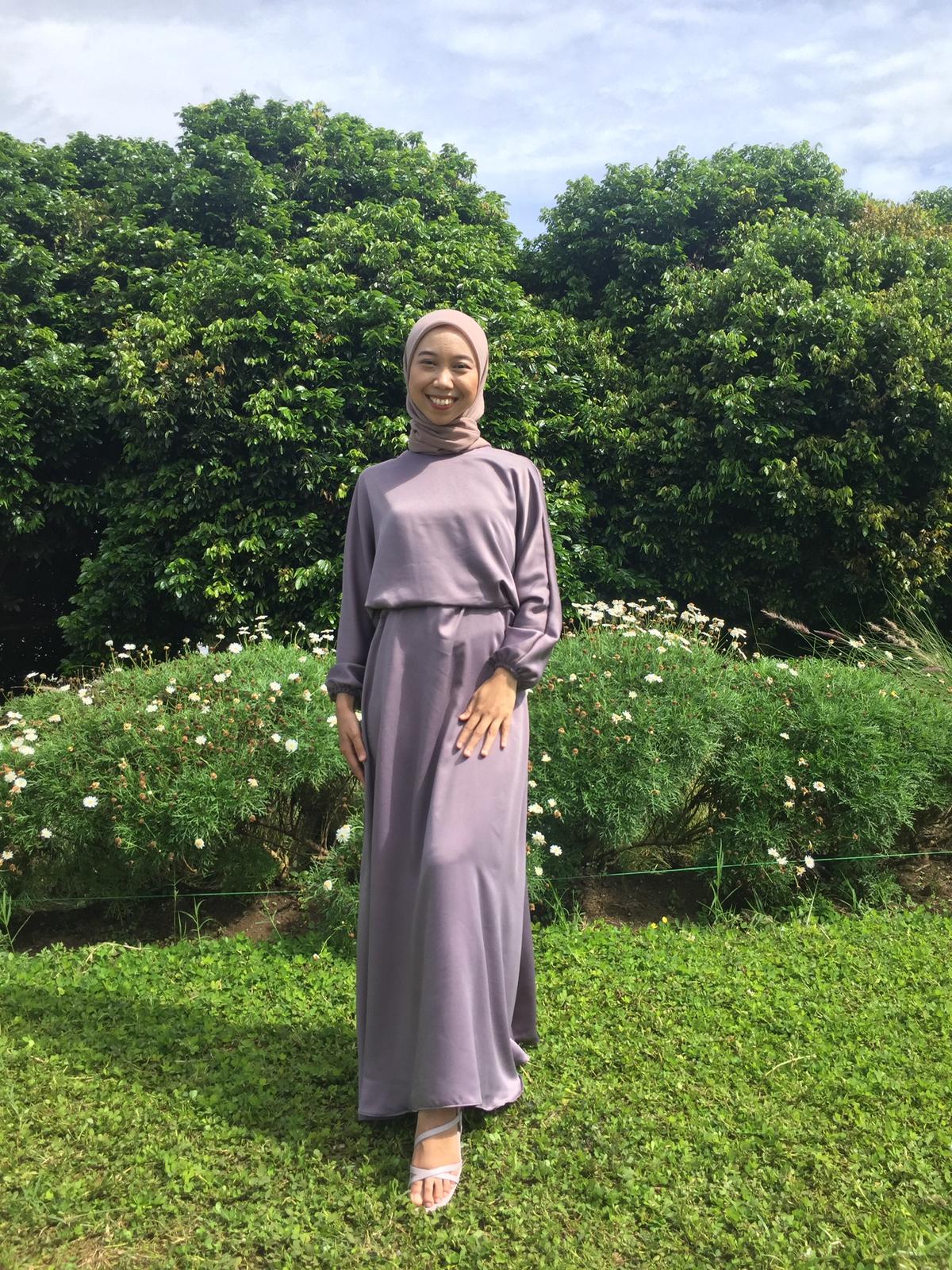
Vita Ika Damayanti
Real participant · Perth 2026
“
Thank you so much Mia, this mock interview is giving me a clear idea for my real interview.
, Vita Ika Damayanti · after Session 2 · April 2026
Before
After 2 sessions
The design artefacts 📌
Built in Miro. Grounded in real data. Each one tells a different part of the same story.
User Persona
Built from Vita's real welcome form data. Confidence scores, goals, frustrations, fears, and her actual words from the pre-session form.
Real participant data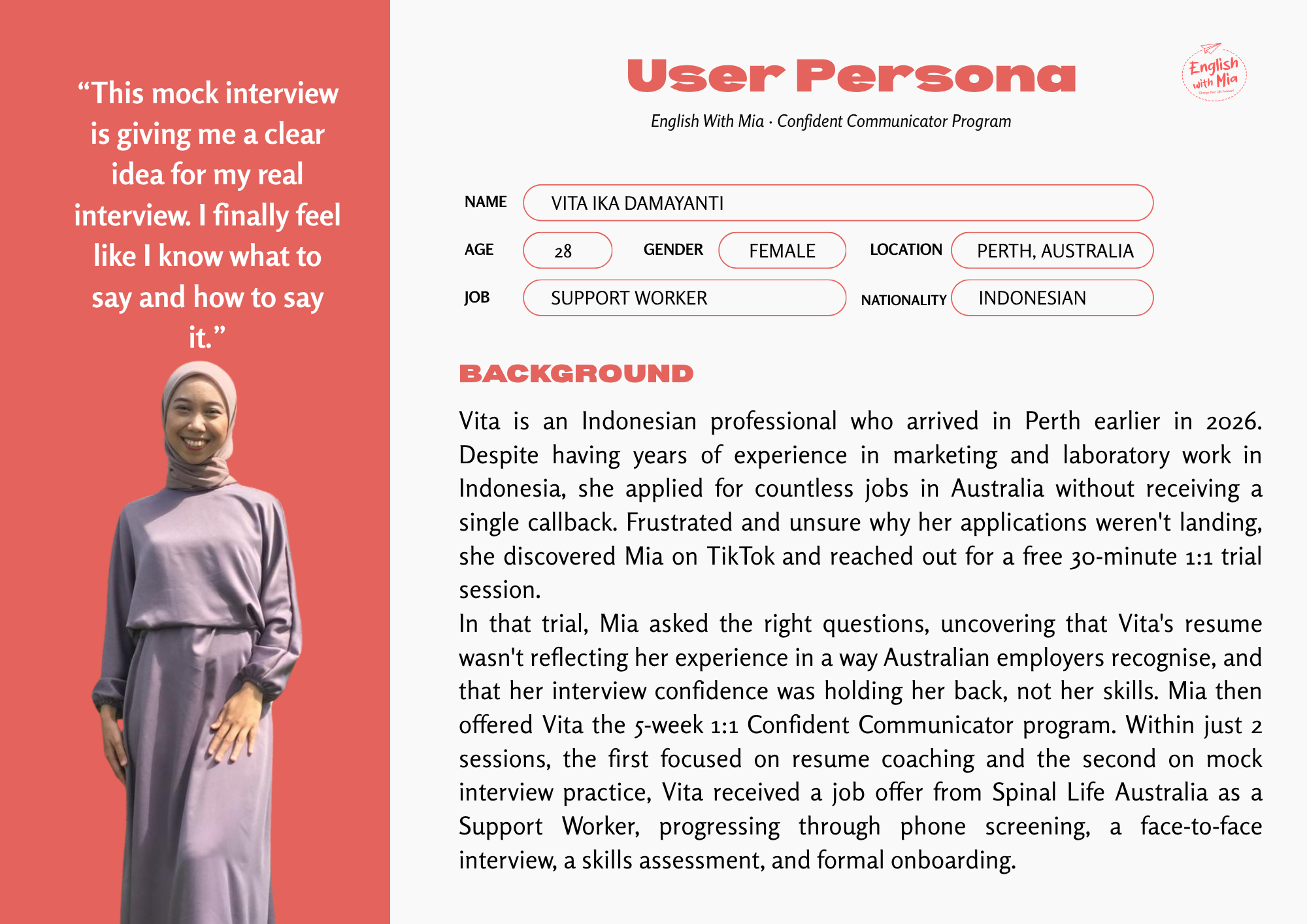
Stakeholder Map
Power and interest grid using Mendelow's Matrix. Maps Mia, Vita, Nur, 14 community interviewees, employers, IELTS bodies, and TikTok as a trust channel.
Mendelow 1991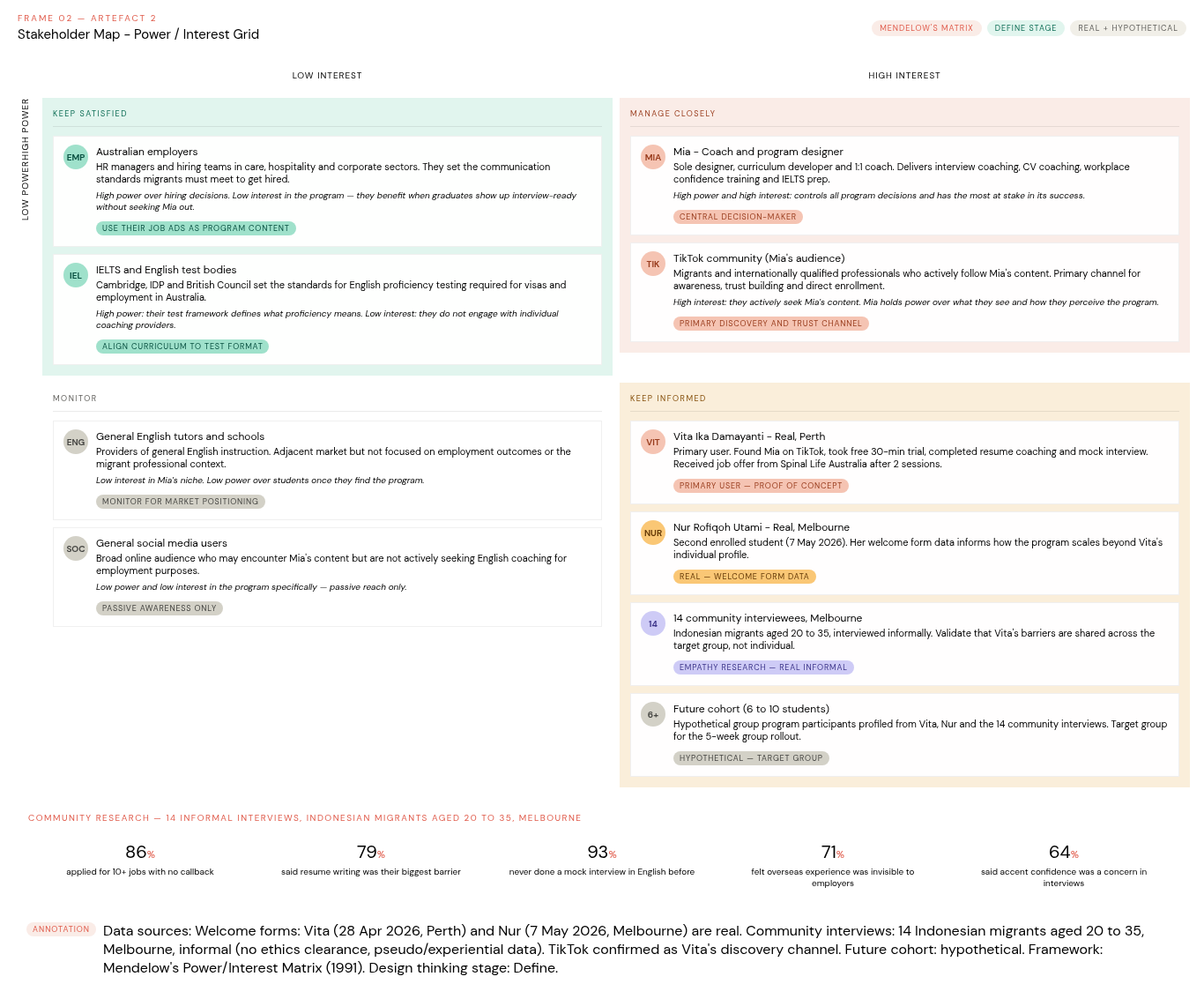
User Journey Map
Vita's emotional arc across 6 stages from arriving in Perth with zero callbacks to receiving a job offer from Spinal Life Australia.
Real journey · 6 stages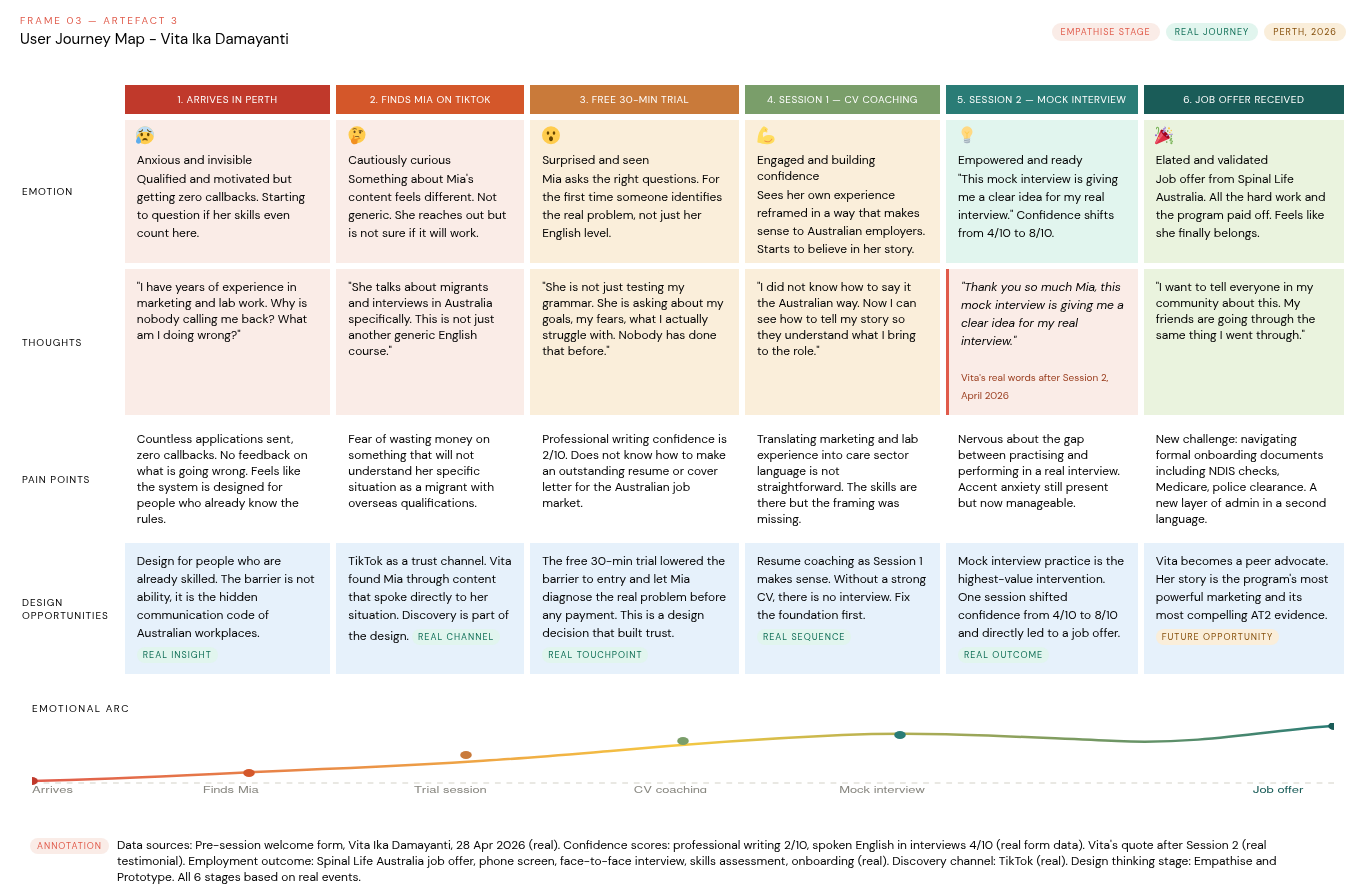
Stanford Model and Growth Framework
Customised 5-stage design thinking model with real activities, honest limitations, and practitioner reflections at every stage.
Stanford d.school · Brown 2008 · Liedtka & Ogilvie 2011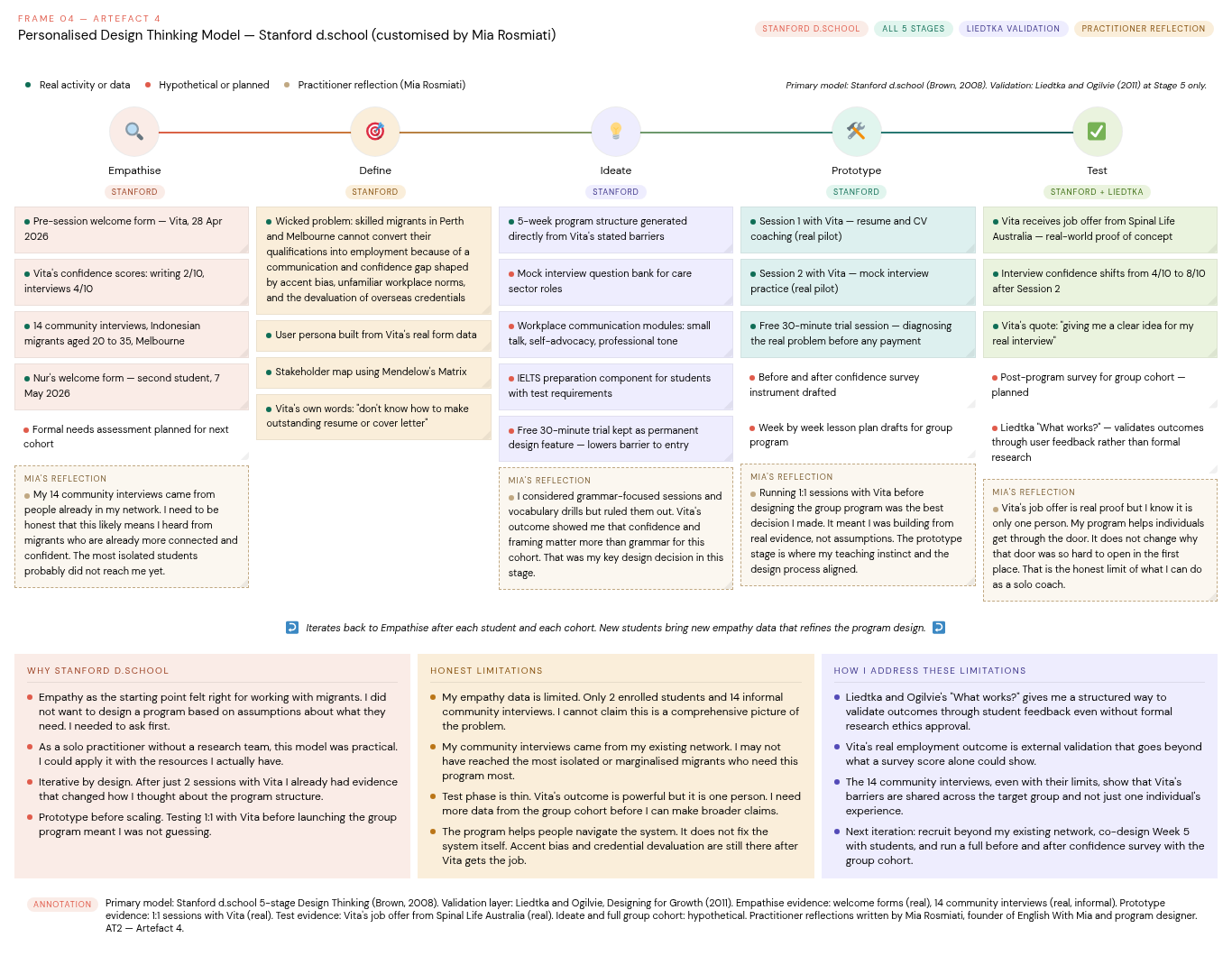
The 5-week program 🍓
Every week was designed from a real insight. Not a curriculum template. Click a week.
Week 1 · Identity · belonging
Your Voice and Story
Why this week exists
Vita and 14 community members said they didn't know how to present themselves the Australian way. Week 1 fixes that first.
Inside the session
Story-circle, personal pitch, voice warm-ups, accent-as-asset reframe.
Student walks away with
A 60-second professional story each student can use anywhere.
What the design process actually produced 📊
2/10 → 8/10
Interview confidence shift in 2 sessions
0 → 1 job offer
Vita's employment outcome at Spinal Life Australia
14 interviews
Indonesian migrants aged 20, 35 in Melbourne
The honest limit
This program helps individuals navigate the system. It does not change the system itself. Accent bias and credential devaluation are still there after Vita gets the job. That is the boundary of what individual coaching can do, and it is important to name it.
What the research says 📚
25 sources. 6 themes. All connected back to real design decisions.
The literature review for this project selected 25 sources across five themes to justify every design decision made in the program. Brown (2008) grounds the empathy stage. Liedtka and Ogilvie (2011) provide the "What works?" question used to validate Vita's employment outcome. Kolb (1984) explains why mock interviews work better than grammar drills. Peng and Kueh (2022) justify the cultural adaptation of the Stanford model. Noel (2023) names the honest limit of individual coaching. Full literature matrix available in the AT2 submission.
If you are a hiring manager or client, everything you need is above. If you are reviewing my AT2 submission, the full academic version is linked below.
This project is also my university final assignment 🎓
Master of Education (Digital Learning) · Monash University · 2026
The Confident Communicator was designed, documented, and submitted as AT2 for the Master of Education (Digital Learning) at Monash University. Every artefact on this page is real evidence from a real design process. The learning parlour is both the portfolio and the proof.
How it tasted
Vita: job offer at Spinal Life Australia after 2 sessions
Confidence shift 4/10 → 8/10 in interviews
14 community interviews informing the program
Liked this flavour? Let's chat over a scoop.
30 minutes, no commitment. Bring your project, your problem, or just your curiosity.
Book 30-Min Tasting Session with Mia 🍦